
Root Canal Therapy
Saving the Tooth. Removing the Infection. Protecting the Foundation.
Root canal therapy is a highly effective restorative procedure used to preserve a natural tooth when infection or inflammation reaches the inner pulp. By removing the source of pain and protecting the remaining structure, root canal treatment helps restore comfort, function, and long-term stability.
What Root Canal Therapy Is
Preserving a Tooth That Might Otherwise Be Lost
Inside every tooth is a central chamber that contains pulp tissue, nerves, and blood supply. When this inner area becomes infected or severely inflamed — often because of deep decay, fracture, trauma, or repeated dental treatment — the tooth can become painful, sensitive, and structurally vulnerable.
Root canal therapy removes that damaged internal tissue, disinfects the inside of the tooth, seals the canals, and allows the remaining tooth structure to be preserved rather than extracted.
In many cases, this is the procedure that saves the tooth and restores the mouth to a healthier, more stable condition.
Why Root Canal Treatment Becomes Necessary
When the Pulp Has Been Compromised
Root canal treatment is typically recommended when bacteria or trauma reach the nerve space of the tooth. Once the pulp is badly inflamed or infected, the problem does not resolve on its own. Without treatment, discomfort often worsens and the tooth may eventually require extraction.
A tooth may need root canal therapy because of deep decay, a crack that allows bacteria to enter the tooth, a large failing restoration, repeated procedures on the same tooth, or injury that affects the pulp over time.
The goal is not simply to stop pain. It is to eliminate infection while preserving the natural tooth whenever possible.
Common Signs and Symptoms
How Patients Know Something Is Wrong
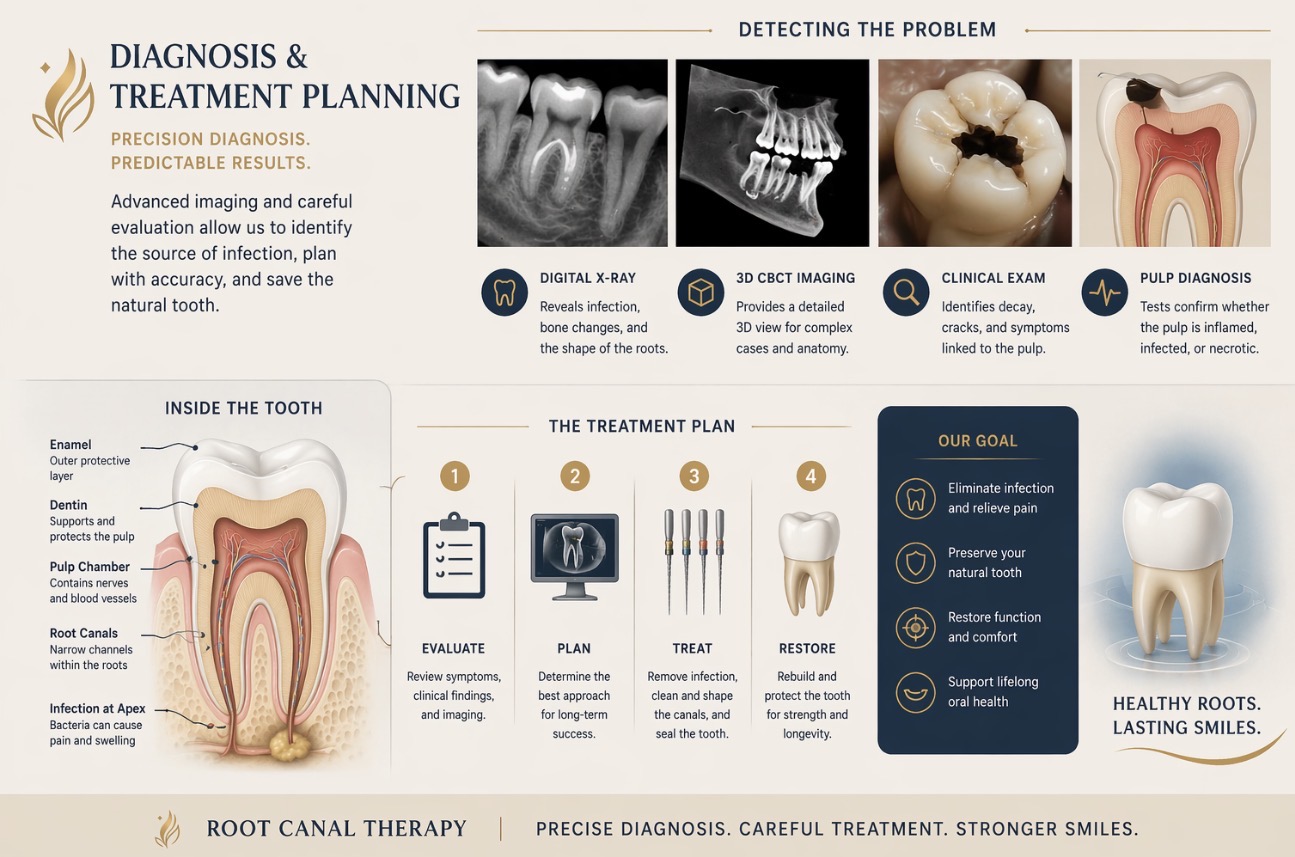
Not every infected tooth presents the same way. Some patients experience intense sensitivity or pain, while others notice pressure, swelling, or a feeling that a tooth is “not right.” Occasionally, infection may be present with surprisingly little discomfort, which is why imaging and examination are so important.
Some teeth show clear symptoms. Others reveal their condition only through careful clinical evaluation and digital imaging.
The Root Canal Process
What Happens During Treatment
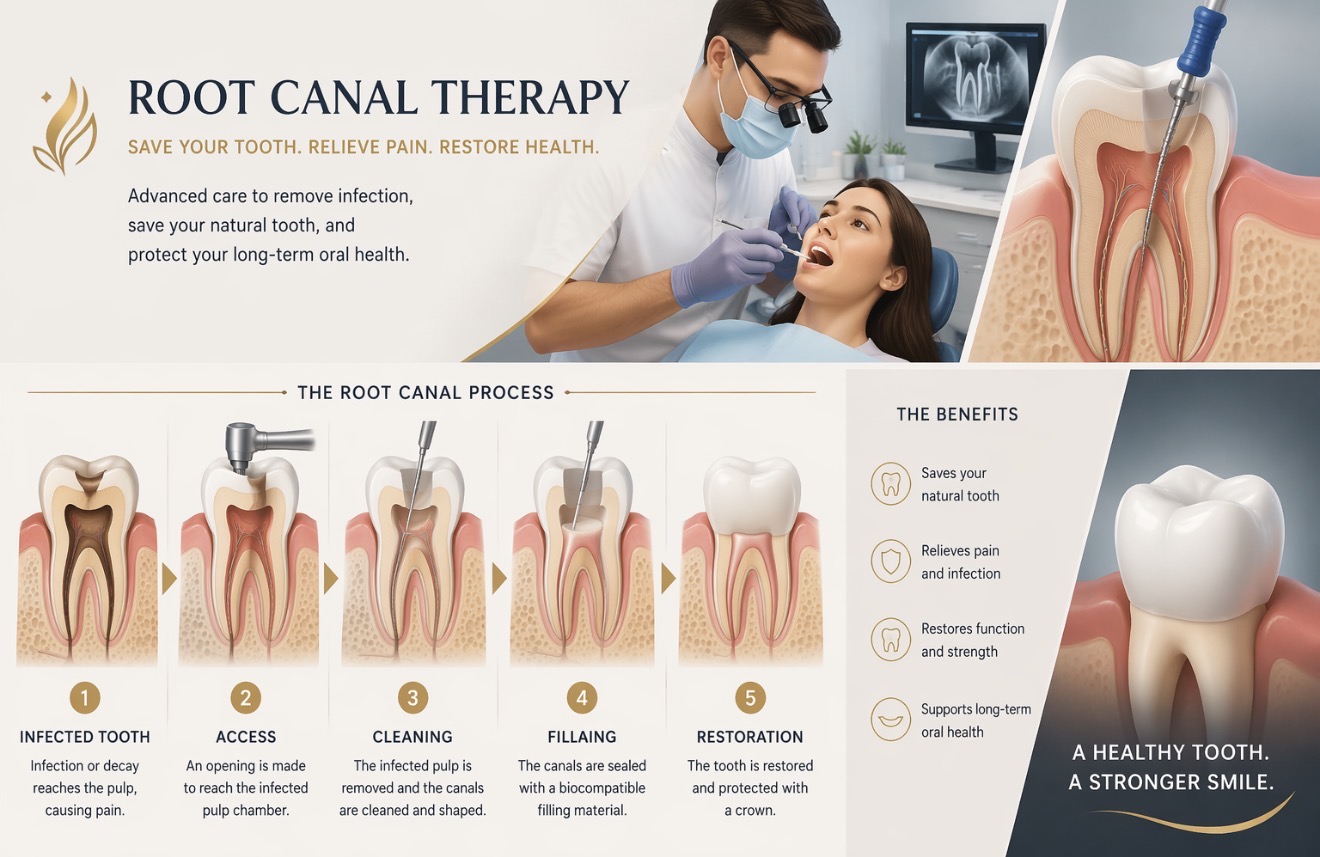
Root canal therapy is a precise, step-by-step restorative procedure designed to eliminate infection while preserving as much healthy tooth structure as possible.
1. Diagnosis
We evaluate the tooth clinically and radiographically to determine the extent of infection or pulp damage and confirm whether root canal treatment is the correct solution.
2. Access and Cleaning
A small access opening is made so the diseased pulp tissue can be removed and the internal canals can be carefully cleaned and shaped.
3. Disinfection and Sealing
Once the canals are disinfected, they are sealed to help prevent reinfection and to stabilize the internal structure of the tooth.
4. Final Restoration
In many cases, the treated tooth is protected with a buildup or crown to restore strength and reduce the risk of fracture going forward.
Why Saving the Natural Tooth Matters
Preservation Is Often the Best Restorative Option
Whenever a tooth can be predictably preserved, it is often preferable to removing it. A natural tooth helps maintain bite stability, chewing efficiency, and the continuity of the dental arch. Saving the tooth can also reduce the need for more extensive replacement treatment later.
Root canal therapy is not just about stopping discomfort. It is part of a broader restorative philosophy: preserve what can be saved, rebuild what has been compromised, and protect the overall foundation of the mouth.
Aftercare and Restoration
What Happens After the Root Canal
Once the infection has been treated, the next priority is protecting the remaining tooth structure. Depending on the tooth and the amount of compromise present, that may involve a bonded restoration, buildup, or crown.
This final restorative phase is important. A tooth that has undergone root canal treatment may become more brittle over time if it is not reinforced properly. The long-term success of the treatment depends not only on eliminating infection, but also on rebuilding the tooth so it can function confidently.
Technology and Precision
Accurate Diagnosis Supports Better Outcomes
Root canal success depends on careful diagnosis, visualization, and meticulous technique. Digital imaging and restorative planning help identify the problem accurately and guide treatment in a way that protects surrounding structures while fully addressing the affected tooth.
In a practice that emphasizes foundational health, root canal therapy is not treated as an isolated emergency. It is approached as part of the larger effort to restore the mouth to stability, preserve valuable tooth structure, and reduce the need for unnecessary loss.
A Better Alternative to Tooth Loss
Root Canal Therapy vs. Extraction
In some cases, an infected tooth is so compromised that extraction becomes necessary. But when the tooth can be saved predictably, root canal therapy is often the more conservative and biologically favorable choice.
Extracting a tooth may solve the immediate infection, but it also creates a new restorative problem: missing support. That can lead to drifting, bite changes, bone loss, and the need for implants or other replacement options. Saving the natural tooth whenever appropriate helps preserve both function and structure.
Begin with an Evaluation
Do Not Ignore a Tooth That May Be Infected
If you are experiencing persistent tooth pain, sensitivity, swelling, or signs that a tooth may be compromised internally, early evaluation is important. Root canal therapy may be the procedure that relieves discomfort, removes infection, and saves the tooth before more extensive treatment becomes necessary.
We will determine whether the tooth can be preserved, explain the restorative plan clearly, and help you move forward with confidence.